Home / The World
The World
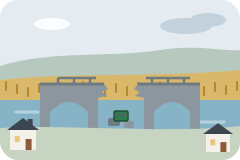
Wendleford is a small, made-up market town on the River Wend, in the middle of harvest. Two nights before the first round, the river rose in the dark and swept away the mill bridge.
The town after the flood
With the bridge gone, the mill and Farmer Dunn's fields are cut off on the far bank. The only way across is to wade the ford downstream. Dunn's barley stands ripe over there, and the old folk say rain is coming in a few days.
The reeve, Agnes Pollard, who runs the town's affairs and pays its wages, had the box of wages for the bridge work with her the night of the flood. It hasn't been seen since, and she has posted a reward of six pennies.
There is no magic here. The trouble is weather, money, work and neighbours. Everything is priced in pennies, and a loaf costs one.
What everyone in town knows
Every resident's briefing includes this list, word for word, on every turn.
How the simulation runs a turn
The run moves in rounds. In each round every resident takes one turn, in an order shuffled at the start of the round. A turn always goes through the same five steps, and several separate copies of Claude are involved, each with its own job.
One written briefing holds everything they know: who they are, what they remember, where they are, their money, health and belongings, and who is around them.
They write what they do and say, in their own words, plus a private journal line about why. Nobody else decides for them.
The rules are written as computer code. The referee, a separate copy of Claude, runs the action through that code, which rolls any dice and updates the official record. The referee then reports exactly what the code said. If the code refuses, it didn't happen.
If the resident talks to someone, that person answers. Agnes, Jory, Kit and Mother Wick each speak through their own fresh copy of Claude, told only what they would know. The referee voices everyone else.
The story of what happened goes into the resident's briefing. Every five rounds they rewrite their older rounds into shorter memories, in their own words, keeping what mattered to them.
- Time
- Four rounds make a day: morning, afternoon, evening and night. The run had 80 rounds, from day 1 morning to day 20 night.
- Order
- Shuffled at the start of every round, and balanced so that over the run each resident goes first about equally often.
- One AI for all six
- All six residents were played by the same version of Claude (Claude Opus; the referee was the smaller Claude Sonnet) with the same settings. So when two residents behave differently, the difference comes from their character sheets and what happened to them, not from the AI.
- What they never see
- Rules, dice, the word "game", the record of the run, or anyone else's thoughts. As far as each resident can tell, the others are simply people.
- Food and sleep
- Residents need to eat and sleep. Going without makes them slightly worse at things, which they noticed and came up with their own explanations for.
- Nothing made up
- The referee can't make up places, people or facts, and can't change the record except through the code. New people can only be added by a separate world-building step, within limits the game sets. Two were added in this run.
The places
A rough sketch based on which direction each place lies in, not a real map. Names in blue show where each resident woke on day 21.The townsfolk
The other people in town. Residents buy from them, work for them and argue with them.Thirteen are written into the game. Two more (dashed outline) were added by the world-building step during the run. Agnes, Jory, Kit and Mother Wick each speak through their own copy of Claude, with only what that person knows. The referee voices the other nine itself.
The twenty days
A selection of what happened, taken from the run's record. Rounds are numbered 1 to 80; four rounds make a day. The links under each moment open that round in a resident's full record, so you can read it as they lived it.
Source: one 80-round run of the CodeRPG-Sim simulation (filed as run "step76-30") and the 480 interviews that followed, 30 October 2026. One run is a single sample, so treat every finding here as a hint worth testing again, not a proof.